How a custom wordle works
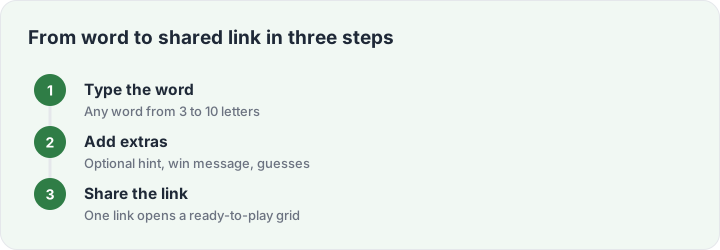
A standard word game gives everyone the same daily word, which is exactly what you do not want when the fun is watching a specific person fail at a word you chose. A custom puzzle flips it: you pick the secret word, and this page turns it into a single link. Whoever opens that link gets a ready-to-play guessing grid — green and yellow tiles, a keyboard, guess tracking, all of it. No app, no account, no “create a room” dance; the entire puzzle lives inside the link itself.
The optional settings are where the teasing happens. A hint stays hidden until the guesser taps the Hint button — perfect for mercy on hard words. A custom win message replaces the standard congratulations with whatever you like; “how did it take you nine tries” is a popular choice. And the guess count scales the difficulty from a merciful eight tries down to a brutal four.
What people actually make
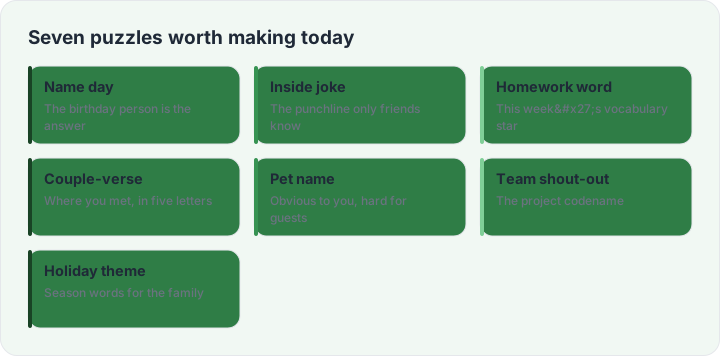
The classics: a birthday puzzle where the answer is the person’s name, an inside-joke word that will make exactly one friend groan, the street where a couple met. Teachers run a small industry of these — weekly vocabulary words, unit review terms, student-made puzzles traded around the classroom, which is its own kind of engagement. The classroom ideas page collects five routines that work without turning the game into a worksheet.
Ready to try one? The maker at the top takes thirty seconds, and the step-by-step guide walks through every option if you want the full tour. When someone sends a puzzle back at you, open it and play — the play page handles the guessing, and your running stats stay on your own device.