Vocabulary drill has a repetition problem: students re-read word lists, recognize the words on the quiz, and forget them by the following week. Retrieval practice — pulling the word from memory instead of looking at it again — is the reliable fix, and a guessing game is retrieval wearing a party hat. Here is the loop that makes it stick.
Why guessing beats re-reading
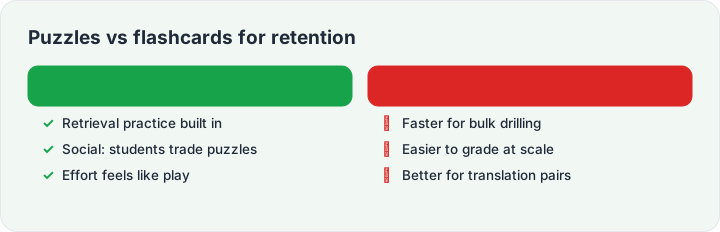
Every guess in a word puzzle is a forced retrieval attempt: the player must search their vocabulary for words that fit the clues the tiles gave. The feedback is instant and specific — green tiles confirm, gray tiles correct. That cycle, attempt then feedback, is precisely what flashcards do well and re-reading does not. The puzzle version adds two advantages: the effort feels voluntary, and the game is social — students compare grids, trade puzzles and boast, which multiplies the number of exposures per word without multiplying the lesson time.
The weekly loop
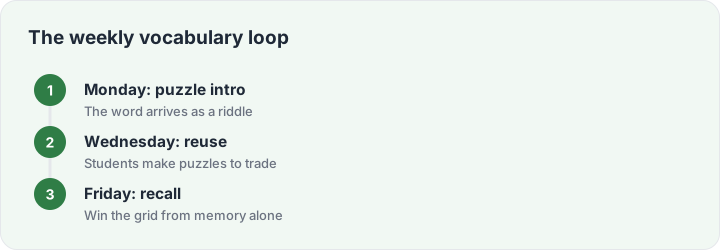
Monday: the target word arrives as a puzzle, hint set to the definition. The win screen shows the word in context — write the win message as the example sentence with the word starred. Wednesday: students who can spell the word make puzzles with it for classmates; making is deeper retrieval than solving, and reading someone’s hint is a second retrieval in disguise. Friday: one last puzzle, no hint, from memory alone. Three retrieval events a week per word, none of them feeling like a quiz.
What makes a good vocabulary puzzle
Curriculum words of four to eight letters work best; longer scientific terms can be clued by their roots (“photo- means light”) which smuggles etymology into the hint system. Names, formulas-as-words and foreign-language targets all work too, because the game checks letter shape rather than a dictionary — a property standard daily games cannot offer. The maker guide covers the settings; the classroom page has five ready-made routines including the spelling swap, which is where student-made puzzles quietly do the heaviest lifting.
Keeping it honest
A game stops teaching when it becomes a ritual. Rotate the routines, let students vote on the cruelest puzzle of the month, and retire any word the class solves in two guesses flat — that word has been retrieved enough; it is time for the next one.