A guessing game earns its place in a classroom only if it does more work than the worksheet it replaced. Custom puzzles clear that bar in specific, repeatable ways — here are five routines teachers actually keep using, with the settings that make each work.
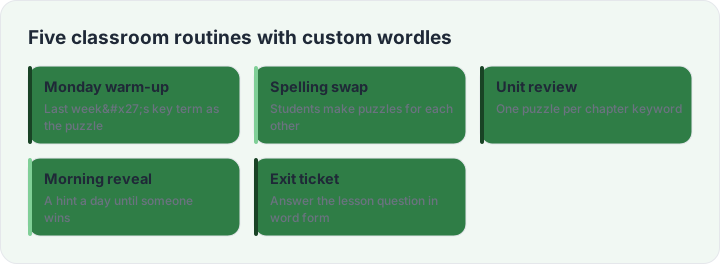
1. The Monday warm-up
Last week’s key term is the answer; the hint is its definition minus the word itself. Five-letter curriculum words are everywhere once you look. The setup that works: five to six letters, six guesses, hint available from the start for younger groups. The whole routine costs five minutes at the top of class and puts the week’s target word in retrieval mode before any teaching starts.
2. The spelling swap
Students make puzzles for each other using this week’s word list, then trade links in pairs. The learning hides in the making: to build a fair puzzle you must spell the word perfectly, and to write a hint you must understand what the word means. Collect the best puzzles and reuse them as next week’s warm-up material — student-authored content with a built-in quality filter, because nobody keeps a broken puzzle.
3. The unit review ladder
One puzzle per chapter keyword, difficulty rising through the unit: early words at six guesses with hints, the final review word at five guesses, no hint. Run the ladder as a class-vs-class or row-vs-row tournament — the emoji result grids make scorekeeping trivial on the board.
4. The morning reveal
One puzzle, several days: Monday the hint is cryptic, Tuesday it sharpens, Wednesday it names the category. Guesses accumulate on paper or in the class chat. The slow-burn version turns one word into a week of small conversations, which is exactly the repetition a hard vocabulary word needs.
5. The exit ticket
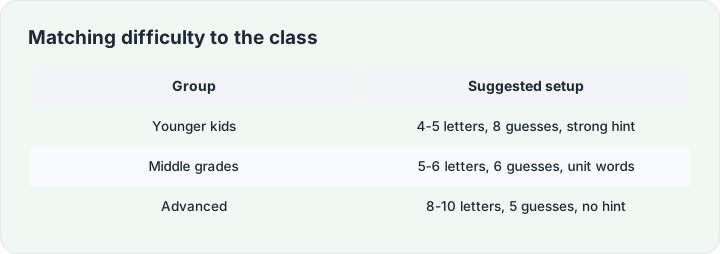
The last five minutes: the answer is the lesson’s core question in word form, guesses happen individually on devices, and the win screen carries the definition. Students who win have retrieved the concept; students who lose click Hint and retrieve it anyway. Either way the vocabulary lands before the bell — no grading, no printing, and the weekly loop turns it into a routine rather than a one-off. Younger classes start with the gentle settings on the difficulty table above; advanced groups get the no-hint treatment and four guesses.